

Opening Overview
The global beauty‑tech market is expanding rapidly, projected to reach $13.34 billion by 2030 with a CAGR of roughly 19.7%. U.S. consumers now expect hyper‑personalized experiences that adapt to real‑time skin conditions, driven by AI‑enabled analysis tools, AR try‑on apps, and smart home devices. At the same time, regulatory scrutiny is intensifying; HIPAA, CCPA, and emerging FDA guidelines demand transparent data handling and safety compliance. Brands are also responding to sustainability pressures, offering refillable, easy‑open packaging and leveraging AI to forecast demand, reduce waste, and develop eco‑friendly formulations. Together, these forces shape a market where technology, personalization, compliance, and environmental responsibility intersect.
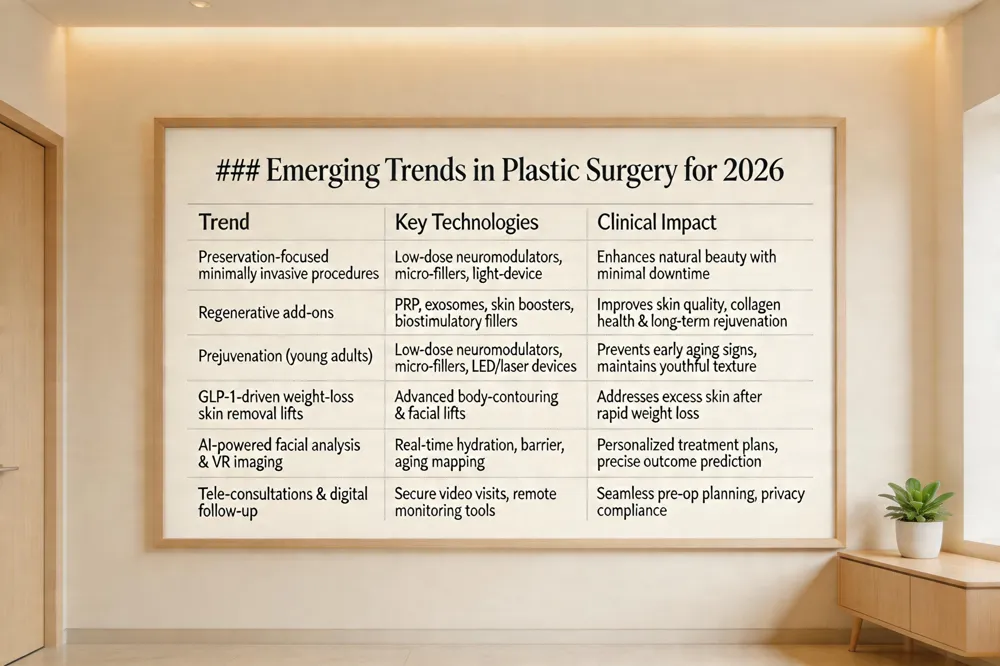
Emerging Trends in Plastic Surgery for 2026
Emerging Trends in Plastic Surgery for 2026
| Trend | Key Technologies | Clinical Impact |
| Preservation‑focused minimally invasive procedures | Low‑dose neuromodulators, micro‑fillers, light‑device maintenance | Enhances natural beauty with minimal downtime |
| Regenerative add‑ons | PRP, exosomes, skin boosters, biostimulatory fillers | Improves skin quality, collagen health and long‑term rejuvenation |
| Prejuvenation (young adults) | Low‑dose neuromodulators, micro‑fillers, LED/laser devices | Prevents early aging signs, maintains youthful texture |
| GLP‑1‑driven weight‑loss skin removal lifts | Advanced body‑contouring & facial lifts | Addresses excess skin after rapid weight loss |
| AI‑powered facial analysis & VR imaging | Real‑time hydration, barrier, aging mapping | Personalized treatment plans, precise outcome prediction |
| Tele‑consultations & digital follow‑up | Secure video visits, remote monitoring tools | Seamless pre‑op planning, compliance with privacy regulations |
| (https://rank-ai-generated-images.s3-us-east-2.amazonaws.com/4561c752-74b2-4d66-95f5-e7121f01f6f2-banner-cd0ccfff-962d-4180-949b-795ba7bb1abc.webp) | ||
| In 2026 the aesthetic field is shifting toward preservation‑focused, minimally invasive procedures that enhance natural beauty rather than dramatic transformation. Regenerative treatments such as PRP, exosomes, skin boosters, and biostimulatory fillers are becoming standard add‑ons to improve skin quality and collagen health. Younger adults are embracing “prejuvenation” with low‑dose neuromodulators, micro‑fillers, and light‑device maintenance, while rapid‑recovery protocols and advanced medications shorten downtime. The surge in GLP‑1‑driven weight loss is driving demand for skin‑removal lifts, refined body‑contouring, and facial rejuvenation that address excess skin after rapid weight loss. AI‑powered facial analysis platforms and virtual‑reality imaging now guide personalized treatment plans by mapping hydration, barrier function, and aging signs in real time. Tele‑consultations and digital follow‑up tools have become routine, allowing seamless pre‑operative planning, remote monitoring, and post‑procedure care while maintaining compliance with privacy regulations. |
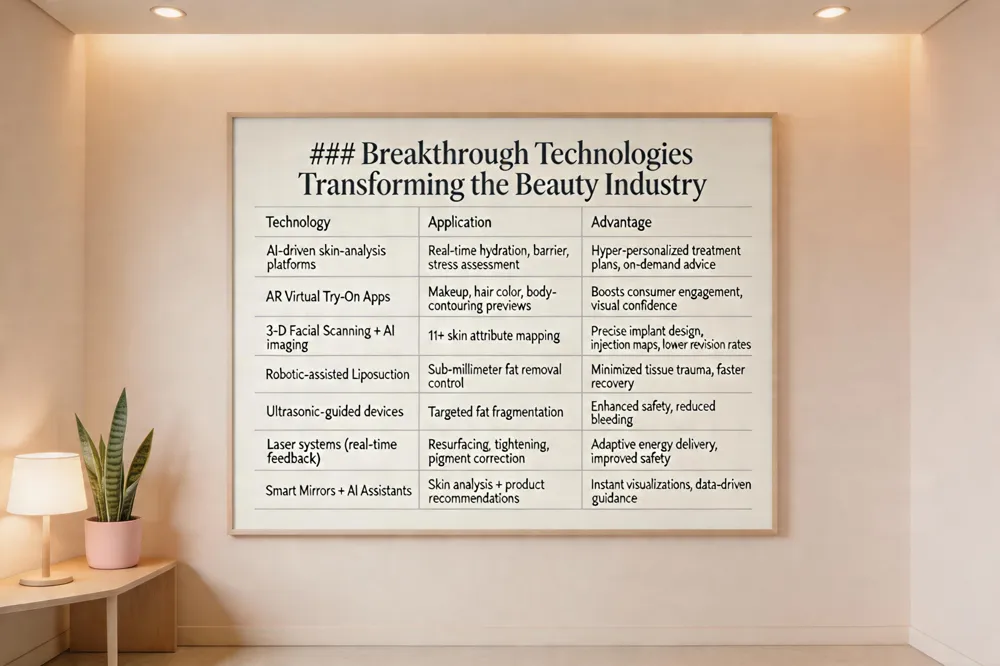
Breakthrough Technologies Transforming the Beauty Industry
Breakthrough Technologies Transforming the Beauty Industry
| Technology | Application | Advantage |
| AI‑driven skin‑analysis platforms | Real‑time hydration, barrier, stress assessment | Hyper‑personalized treatment plans, on‑demand advice |
| Augmented‑Reality (AR) virtual try‑on apps | Makeup, hair color, body‑contouring previews | Boosts consumer engagement, visual confidence |
| High‑resolution 3‑D facial scanning + AI imaging | Surgeon‑level mapping of 11+ skin attributes | Precise implant design, injection maps, lower revision rates |
| Robotic‑assisted liposuction | Fat removal with sub‑millimeter control | Minimized tissue trauma, faster recovery |
| Ultrasonic‑guided devices | Targeted fat fragmentation | Enhanced safety, reduced bleeding |
| Laser systems with real‑time feedback sensors | Resurfacing, tightening, pigment correction | Adaptive energy delivery, improved safety |
| Smart mirrors & generative‑AI assistants | Integrated skin‑analysis + product recommendations | Instant visualizations, data‑driven guidance |
| (https://rank-ai-generated-images.s3-us-east-2.amazonaws.com/4561c752-74b2-4d66-95f5-e7121f01f6f2-banner-2083a5d3-8dcf-4f15-a08f-802550193cf4.webp) | ||
| AI‑driven skin‑analysis platforms now assess hydration, barrier function and environmental stressors in real time, delivering hyper‑personalized treatment plans and on‑demand beauty advice. Augmented‑reality (AR) virtual try‑on apps, deployed by retailers such as Sephora and Ulta, let consumers preview makeup shades, hair color and even body‑contouring outcomes, boosting engagement while still grappling with cross‑device color accuracy. High‑resolution 3‑D facial scanning and AI‑enhanced imaging provide surgeon‑level insights—capturing 11+ skin attributes and generating custom implant designs or precise injection maps that improve precision and reduce revision rates. Robotic‑assisted liposuction and ultrasonic‑guided devices now offer sub‑millimeter control of fat removal, minimizing tissue trauma and shortening recovery. Laser systems equipped with real‑time feedback sensors adjust energy delivery on the fly, enhancing safety for resurfacing, tightening and pigment correction. Smart mirrors and generative‑AI assistants integrate skin‑analysis data with product recommendations, delivering instant visualizations and data‑driven guidance that increase patient confidence and streamline in‑office workflows. Together, these innovations are shifting the U.S. market from static, “personalized” solutions toward responsive, continuously monitored beauty experiences. |
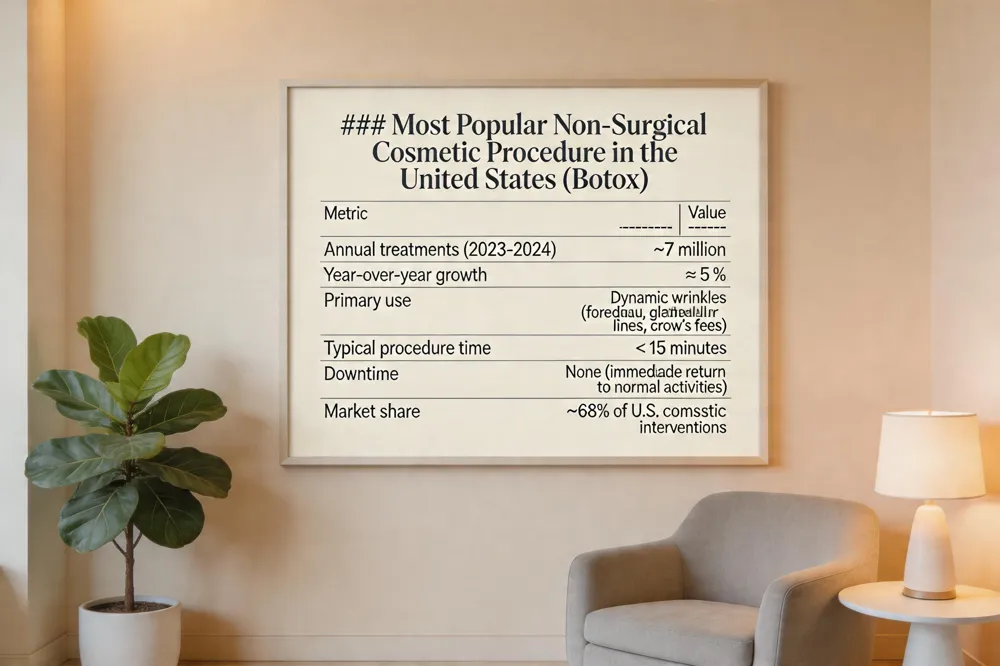
The Most Popular Non‑Surgical Cosmetic Procedure in the United States
Most Popular Non‑Surgical Cosmetic Procedure in the United States (Botox)
| Metric | Value |
| Annual treatments (2023‑2024) | ~7 million |
| Year‑over‑year growth | ≈ 5 % |
| Primary use | Dynamic wrinkles (forehead, glabellar lines, crow’s feet) |
| Typical procedure time | < 15 minutes |
| Downtime | None (immediate return to normal activities) |
| Market share among non‑surgical procedures | ~68 % of U.S. cosmetic interventions |
| (https://rank-ai-generated-images.s3-us-east-2.amazonaws.com/4561c752-74b2-4d66-95f5-e7121f01f6f2-banner-90996869-be76-43b7-b623-51d550ec6a53.webp) | |
| Botox is the clear leader among non‑surgical cosmetic interventions in the United States. Recent ASPS data show that injectable neuromodulators like Botox account for the bulk of minimally invasive procedures, with millions of treatments administered annually and a steady year‑over‑year growth of roughly 5 %. The product’s primary use is the treatment of dynamic wrinkles—those caused by repeated muscle contraction—particularly on the forehead, between the eyebrows (glabellar lines), and around the eyes (crow’s feet). By temporarily blocking acetylcholine release, Botox relaxes the underlying muscles, smoothing these lines within days. Patients favor Botox because the procedure is quick (often completed in under 15 minutes), involves no anesthesia, and carries minimal downtime; most resume normal activities immediately. This convenience, combined with consistent, visible results, drives its high adoption rate and makes it the most popular non‑surgical cosmetic option in the U.S. |
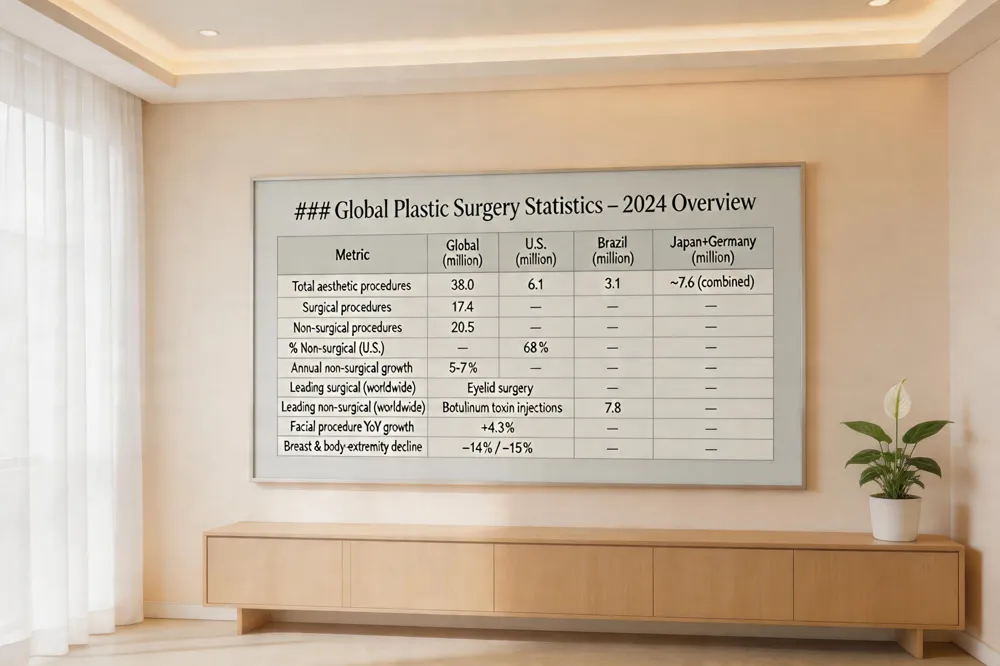
Global Plastic Surgery Statistics: A 2024 Overview
Global Plastic Surgery Statistics – 2024 Overview
| Metric | Global (million) | United States (million) | Brazil (million) | Japan + Germany (million) |
| Total aesthetic procedures | 38.0 | 6.1 | 3.1 | ~7.6 (combined) |
| Surgical procedures | 17.4 | — | — | — |
| Non‑surgical procedures | 20.5 | — | — | — |
| % Non‑surgical of total (U.S.) | — | 68 % | — | — |
| Annual growth rate (non‑surgical) | 5‑7 % | — | — | — |
| Leading surgical procedure (worldwide) | Eyelid surgery | — | — | — |
| Leading non‑surgical procedure (worldwide) | Botulinum toxin injections | 7.8 | — | — |
| Facial procedure YoY growth | +4.3 % | — | — | — |
| Breast & body‑extremity surgery decline | –14 % / –15 % | — | — | — |
| (https://rank-ai-generated-images.s3-us-east-2.amazonaws.com/4561c752-74b2-4d66-95f5-e7121f01f6f2-banner-29d71685-dc0f-4c9d-8509-f42fe435a8d0.webp) | ||||
| Globally, approximately 38 million aesthetic procedures were performed in 2024, with surgical operations accounting for about 17.4 million and non‑surgical treatments for roughly 20.5 million. The United States performed the most procedures—over 6.1 million—followed by Brazil (≈3.1 million), Japan and Germany, which together represent roughly 40 % of the global total. In the U.S., non‑surgical interventions comprised about 68 % of all cosmetic procedures, driven largely by injectable neuromodulators and dermal fillers. Minimally invasive, non‑surgical treatments now make up more than 60 % of the worldwide aesthetic volume and are expanding at a 5‑7 % annual rate. Eyelid surgery has become the leading surgical procedure globally, overtaking liposuction, while botulinum toxin injections remain the most common non‑surgical treatment with about 7.8 million procedures. Facial procedures grew 4.3 % year‑over‑year, whereas breast and body‑extremity surgeries declined 14 % and 15 % respectively. |
Best Non‑Surgical Facelift Solutions for Jowls
Best Non‑Surgical Facelift Solutions for Jowls
| Procedure | Mechanism | Duration of Effect | Typical Cost (USD) |
| PDO/PLLA Thread Lift | Sub‑dermal absorbable sutures → immediate lift + collagen stimulation | 6‑12 months | $2,500‑$7,000 |
| RF Microneedling (Morpheus8) | Fractional RF via micro‑needles → SMAS & dermis tightening, neocollagenesis | 6‑12 months | $1,500‑$4,500 |
| Focused Ultrasound (Ultherapy/HIFU) | Deep SMAS heating → gradual tightening, jawline lift | 12‑18 months | $2,000‑$5,000 |
| Hyaluronic‑Acid Filler Placement | Volume restoration along jawline | 12‑18 months (depends on filler) | $800‑$1,500 per syringe |
| Combination Protocol (Thread + RF/Ultherapy + HA) | Staged multimodal approach for lift, tightening, contour | Up to 18‑24 months | $5,000‑$10,000 total |
| (https://rank-ai-generated-images.s3-us-east-2.amazonaws.com/4561c752-74b2-4d66-95f5-e7121f01f6f2-banner-04ef50ce-81b1-4c4a-bee5-bba2715f817c.webp) | |||
| Non‑surgical rejuvenation of the jowls now relies on a staged, multimodal approach that blends mechanical lift, deep tissue tightening, and targeted volume restoration. |
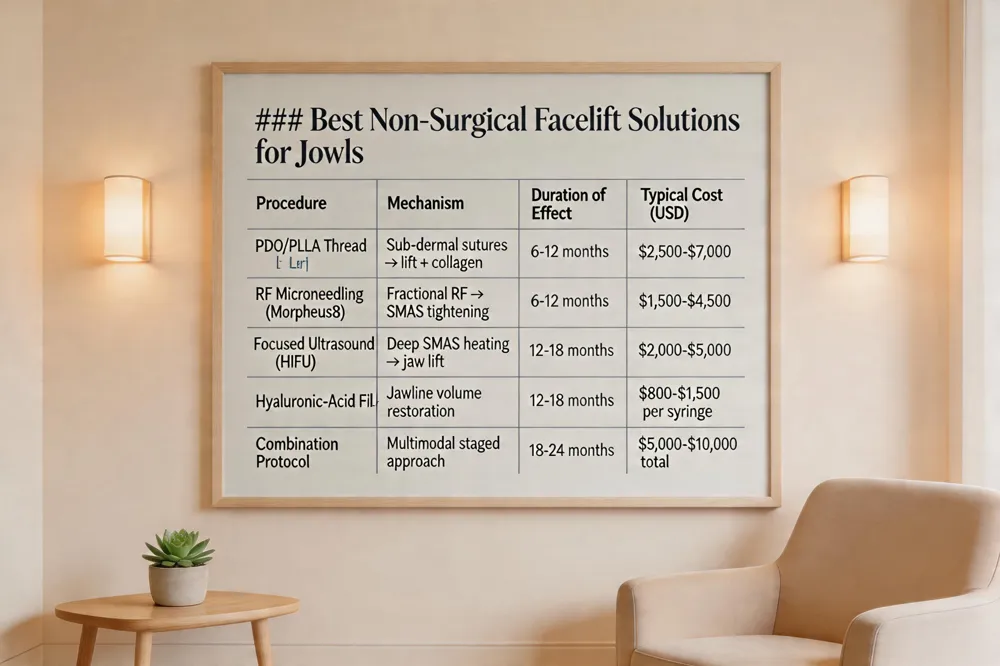
PDO/PLLA Thread Lifts – Absorbable sutures are placed sub‑dermally along the mandibular border, providing an immediate lift while stimulating collagen synthesis that continues for 6‑12 months.
Radio‑Frequency Microneedling (Morpheus8) – This device delivers fractional RF energy through micro‑needles, tightening the SMAS and dermis, improving skin texture, and prompting neocollagenesis.
Focused Ultrasound (Ultherapy/HIFU) – Ultrasound waves heat the deep SMAS layer, causing gradual tightening and a natural‑looking jawline lift over 2‑3 months.
Hyaluronic‑Acid Filler Placement – Fillers are strategically injected along the jawline to restore lost volume, smooth the transition between chin and neck, and enhance definition.
Combination Treatment Protocols – The most effective regimen layers a PDO/PLLA thread lift for lift, followed by RF microneedling or focused ultrasound for tissue tightening, and finishes with HA fillers for contour refinement. This synergistic protocol delivers a durable, natural result for patients seeking a non‑surgical solution to jowls.
Advancements in Plastic Surgery: From Planning to Recovery
Advancements in Plastic Surgery – From Planning to Recovery
| Stage | Technology | Benefit |
| Pre‑operative planning | 3‑D imaging + AI‑driven simulation | Patient‑specific models, millimetric outcome prediction |
| Intra‑operative execution | Laser‑assisted & ultrasonic‑assisted liposuction | Less bleeding, shorter operative time, faster recovery |
| Regenerative augmentation | Sculptra, stem‑cell‑enriched fat grafts | Long‑lasting volume, improved skin quality |
| Mechanical lift | Dissolvable thread lifts, PDO/PLLA sutures | Subtle lift, neocollagenesis, minimal downtime |
| Post‑procedure monitoring | AI‑powered skin analysis, remote monitoring platforms | Real‑time adjustments, early complication detection |
| At‑home continuity | Smart beauty devices, AR‑enabled mirrors | Ongoing skin monitoring, product testing, treatment reinforcement |
| (https://rank-ai-generated-images.s3-us-east-2.amazonaws.com/4561c752-74b2-4d66-95f5-e7121f01f6f2-banner-5d860091-17d2-41c4-a85f-5b200152c2cc.webp) | ||
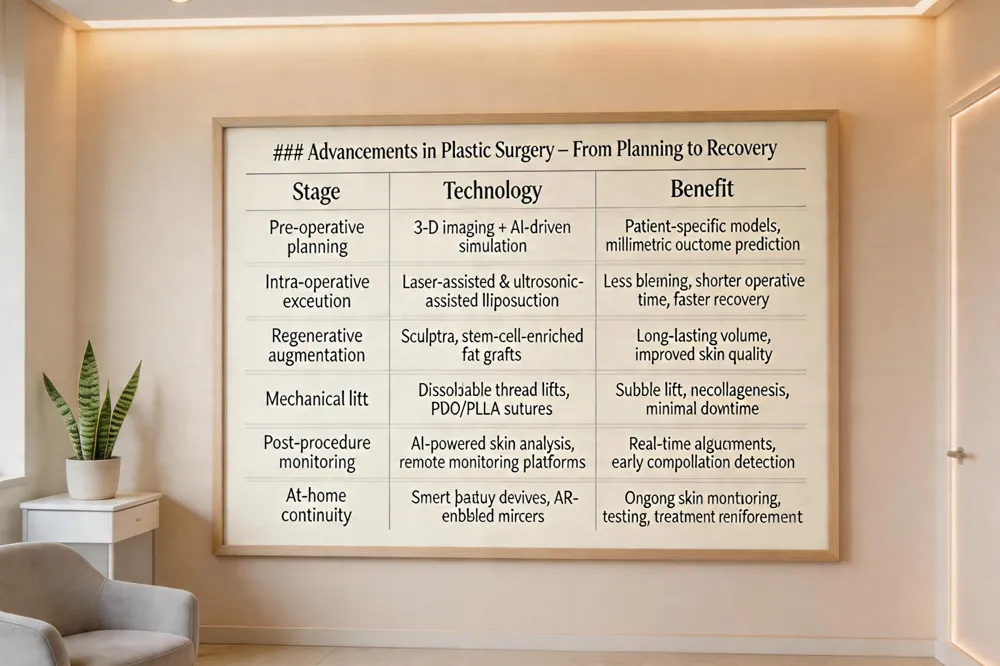
| Modern plastic surgery has been transformed by a suite of high‑tech tools that streamline every phase from pre‑operative planning to post‑procedure care. Three‑dimensional imaging combined with artificial‑intelligence‑driven planning platforms now allows surgeons to create patient‑specific anatomical models, simulate incisions and predict aesthetic outcomes with millimetric precision, reducing intra‑operative surprises and improving patient communication. Liposuction has become less invasive through laser‑assisted and ultrasonic‑assisted devices that fragment adipose tissue while preserving surrounding structures, resulting in less bleeding, shorter operative time and faster recovery. Regenerative biostimulants such as Sculptra and stem‑cell‑enriched fat grafts stimulate native collagen production, offering longer‑lasting volume and skin quality improvements. Thread lifts and dissolvable sutures provide a subtle lift by mechanically repositioning tissue and triggering neocollagenesis, with minimal downtime and natural results. Virtual consultations, AI‑powered skin analysis and remote monitoring platforms keep patients engaged, enable real‑time adjustments to after‑care protocols and enhance safety by early detection of complications. In addition, smart home beauty devices and AR‑enabled mirrors allow patients to continue skin monitoring and product testing at home, reinforcing treatment continuity and outcomes. |
Cost, Access, and Patient Experience with Non‑Invasive Procedures
Cost, Access & Patient Experience – Non‑Invasive Procedures
| Procedure | Cost per Session (USD) | Typical Interval | 3‑Year Cumulative Cost (USD) | Notes |
| Non‑surgical facelift (composite) | $1,500‑$4,500 | Every 6‑18 months | $7,000‑$15,000 | Comparable to surgical facelift over time |
| Thread lift | $2,500‑$7,000 | Every 12‑18 months | $7,500‑$21,000 | Stimulates collagen, gradual lift |
| RF skin tightening | $1,500‑$4,500 | Every 12‑18 months | $4,500‑$13,500 | Improves texture, laxity |
| Ultherapy (focused ultrasound) | $2,000‑$5,000 | Every 12‑18 months | $6,000‑$15,000 | Deep SMAS tightening |
| Botox | $10‑$20 per unit (≈ $300‑$600 per session) | Every 3‑4 months | $2,700‑$5,400 | Quick, no downtime |
| Hyaluronic‑acid filler | $800‑$1,500 per syringe | Every 6‑12 months | $2,400‑$6,000 | Restores volume, contour |
| Laser resurfacing | $1,000‑$3,000 | Every 12‑18 months | $3,000‑$9,000 | Improves tone, pigment |
| Chemical peel | $150‑$400 per peel | Every 4‑6 months | $600‑$2,400 | Exfoliation, brightening |
| Microneedling with RF | $200‑$500 per session | Every 3‑6 months | $1,200‑$3,000 | Collagen remodeling, tightening |
| Tele‑consultation (initial) | $0‑$150 (often covered) | One‑time | — | Convenience, privacy‑compliant |
| (https://rank-ai-generated-images.s3-us-east-2.amazonaws.com/4561c752-74b2-4d66-95f5-e7121f01f6f2-banner-3d288d99-0993-4909-9265-0d3869e42272.webp) | ||||
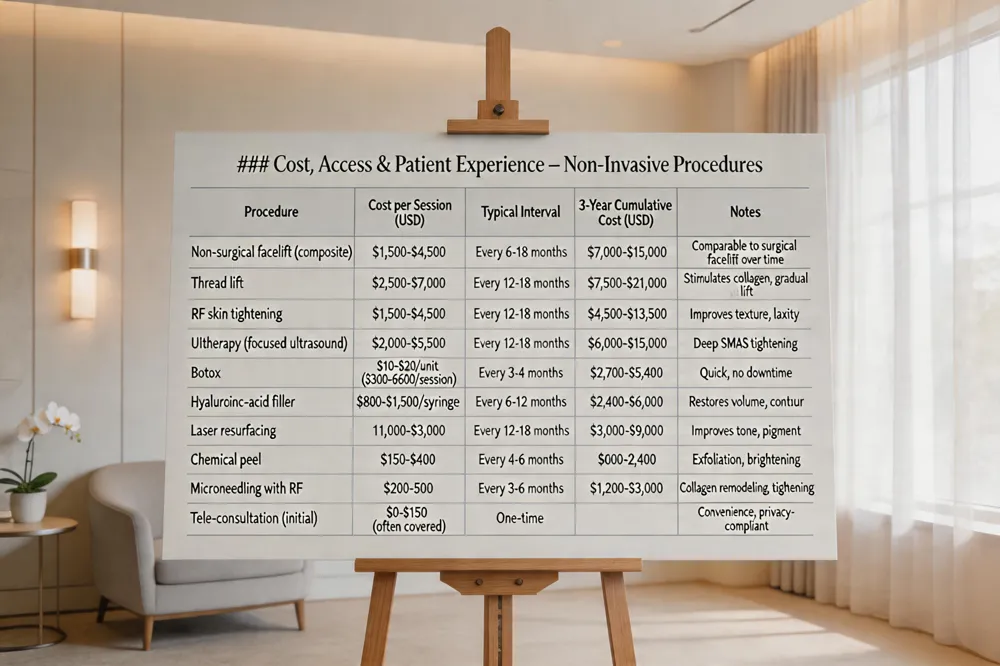
| Non‑surgical facelift cost – Treatments typically range from $1,500‑$4,500 per session. Thread lifts $2,500‑$7,000, RF skin tightening $1,500‑$4,500, and Ultherapy $2,000‑$5,000. Because results are gradual and require repeat visits every 6‑18 months, cumulative expense over several years may approach $7,000‑$15,000, comparable to a traditional surgical facelift. Budgeting for ongoing maintenance is essential. |
Non‑invasive cosmetic procedures near me – Julie Kupersmith, MD, PC offers a full menu of FDA‑approved treatments in the United States, including BOTOX®, Dysport®, Juvéderm®, Belotero®, Restylane®, Radiesse®, Sculptra®, Morpheus8, thread lifts, fractional CO₂ laser, photofacials, Ultherapy®, and RF body tightening. Personalized plans are created during a consultation based on your aesthetic goals.
Top 5 non‑surgical cosmetic procedures – 1️⃣ Botox injections for dynamic wrinkles; 2️⃣ Hyaluronic‑acid dermal fillers for volume and contour; 3️⃣ Laser skin resurfacing for texture, tone, and pigment; 4️⃣ Chemical peels for exfoliation and brightening; 5️⃣ Microneedling with RF for collagen remodeling and tightening.
Will AI replace aestheticians? – No. AI augments clinicians by delivering precise skin analysis, predictive outcome modeling, and hyper‑personalized recommendations, allowing aesthetic professionals to focus on nuanced, human aspects of care.
Technology ecosystem in modern cosmetics – AR‑driven virtual try‑ons, AI‑powered skin diagnostics, high‑resolution 3‑D facial scanning, robotic‑assisted liposuction, laser/RF energy devices, smart home beauty tools (LED masks, micro‑current), and 3‑D‑printed sustainable packaging all converge to create personalized, low‑downtime experiences.
Overall cost considerations for multiple sessions – Simple injectables start at a few hundred dollars; multi‑step programs (laser, peels, microneedling, PRP) begin around $1,000 and can exceed $8,000. Packages are valid for three years, with discounts for bulk purchases and a $500 refundable deposit for procedures over $1,000.
Country leading in plastic surgery volume – The United States remains the global leader, performing over 7.4 million cosmetic surgeries in 2021, accounting for roughly 22 % of worldwide procedures.
Closing Thoughts
The convergence of AI-driven analysis, AR try‑on, and smart home devices enables personalized beauty regimens, while clinicians leverage data to enhance outcomes. Patients can expect seamless, responsive care and practitioners will benefit from accelerated innovation cycles.