
Welcome to Your Cosmetic Surgery Journey
This guide is designed to help prospective patients navigate cosmetic surgery by outlining key considerations, safety standards, and recovery expectations. Selecting a board‑certified plastic surgeon is essential—such surgeons have completed accredited residencies, passed rigorous examinations administered by the American Board of Plastic Surgery, and maintain ongoing education, ensuring they possess the expertise to perform procedures safely and achieve high satisfaction rates. Personalized patient care further enhances outcomes: surgeons assess individual anatomy, health status, and aesthetic goals, develop customized treatment plans, and provide detailed pre‑ and post‑operative instructions to support optimal healing and realistic expectations.
Understanding Costs and Common Procedures
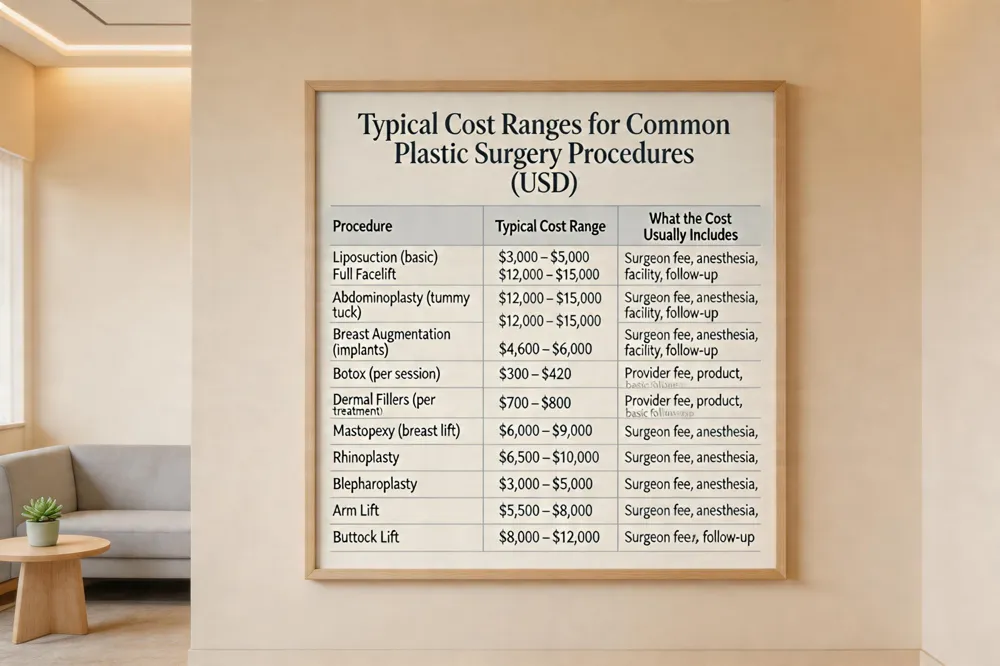
Typical Cost Ranges for Common Plastic Surgery Procedures (USD)
| Procedure | Typical Cost Range | What the Cost Usually Includes |
| Liposuction (basic) | $3,000 – $5,000 | Surgeon fee, anesthesia, facility, follow‑up |
| Full Facelift | $12,000 – $15,000 | Surgeon fee, anesthesia, facility, post‑op care |
| Abdominoplasty (tummy tuck) | $12,000 – $15,000 | Surgeon fee, anesthesia, facility, follow‑up |
| Breast Augmentation (implants) | $4,600 – $6,000 | Surgeon fee, anesthesia, facility, follow‑up |
| Botox (per session) | $300 – $420 | Provider fee, product, basic follow‑up |
| Dermal Fillers (per treatment) | $700 – $800 | Provider fee, product, basic follow‑up |
| Mastopexy (breast lift) | $6,000 – $9,000 | Surgeon fee, anesthesia, facility, follow‑up |
| Rhinoplasty | $6,500 – $10,000 | Surgeon fee, anesthesia, facility, follow‑up |
| Blepharoplasty | $3,000 – $5,000 | Surgeon fee, anesthesia, facility, follow‑up |
| Arm Lift | $5,500 – $8,000 | Surgeon fee, anesthesia, facility, follow‑up |
| Buttock Lift | $8,000 – $12,000 | Surgeon fee, anesthesia, facility, follow‑up |
| (https://rank-ai-generated-images.s3-us-east-2.amazonaws.com/4561c752-74b2-4d66-95f5-e7121f01f6f2-banner-223620a1-339a-4673-a21b-059a40e08631.webp) | ||
| Typical plastic surgery costs in the United States vary by procedure, surgeon expertise, and location. For common facial and body surgeries, surgeon fees range from roughly $3,000 for basic liposuction to $12,000‑$15,000 for a full facelift or abdominoplasty, while breast augmentation averages $4,600‑$6,000 for implants. Non‑invasive treatments such as Botox start at about $300‑$420 per session and dermal fillers average $700‑$800 per treatment. Prices generally include the surgeon’s fee, anesthesia, facility charges, and follow‑up care; additional expenses for labs, compression garments, or medications may apply, and financing options or limited insurance coverage can affect out‑of‑pocket costs. |
Common cosmetic surgery procedures encompass facial refinements—rhinoplasty, blepharoplasty, brow lift, facelift, chin or cheek augmentation—breast‑related surgeries like augmentation, mastopexy, reduction, and implant revision, and body‑contouring operations such as liposuction, abdominoplasty, arm lift, and buttock lift. Non‑surgical adjuncts, including Botox, dermal fillers, chemical peels, and laser resurfacing, are frequently combined with surgery to enhance results.
The most frequently performed procedures list the United States include breast augmentation, liposuction, rhinoplasty, abdominoplasty, breast lift (mastopexy), and blepharoplasty. Among minimally invasive options, Botox injections dominate, followed by hyaluronic‑acid fillers and skin resurfacing techniques.
The top five cosmetic procedures by volume are breast augmentation, liposuction, blepharoplasty, abdominoplasty, and Botox injections, reflecting a blend of surgical and non‑surgical demand for aesthetic improvement.
Patient Safety, Risks, and Surgical Basics
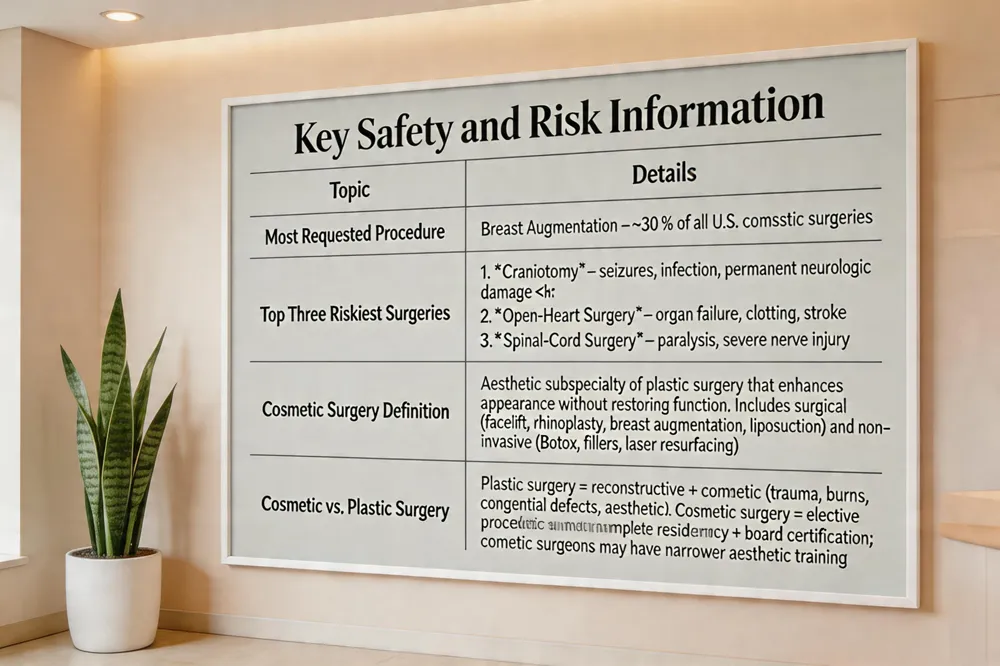
Key Safety and Risk Information
| Topic | Details |
| Most Requested Procedure | Breast Augmentation – ~30 % of all U.S. cosmetic surgeries |
| Top Three Riskiest Surgeries | 1. Craniotomy – seizures, infection, permanent neurologic damage <br>2. Open‑Heart Surgery – organ failure, clotting, stroke <br>3. Spinal‑Cord Surgery – paralysis, severe nerve injury |
| Cosmetic Surgery Definition | Aesthetic subspecialty of plastic surgery that enhances appearance without restoring function. Includes surgical options (facelift, rhinoplasty, breast augmentation, liposuction) and non‑invasive treatments (Botox, fillers, laser resurfacing). |
| Cosmetic vs. Plastic Surgery | Plastic surgery = reconstructive + cosmetic (trauma, burns, congenital defects, aesthetic). Cosmetic surgery = elective aesthetic procedures only. Plastic surgeons complete a dedicated residency and board certification; cosmetic surgeons may have narrower aesthetic training. |
| (https://rank-ai-generated-images.s3-us-east-2.amazonaws.com/4561c752-74b2-4d66-95f5-e7121f01f6f2-banner-9bd4b554-6d74-4ad7-80a3-bddd40898439.webp) | |
| What is the most requested plastic surgery procedure? | |
| Breast augmentation leads U.S. cosmetic surgery, accounting for about 30 % of all procedures. It restores breast volume with FDA‑approved silicone or saline implants, and most patients resume light activities within a week. |
What are the top three riskiest surgeries?
Brain, heart and spinal‑cord operations carry the greatest risk. Craniotomies risk seizures, infection and permanent neurologic damage; open‑heart surgery can cause organ failure, clotting and stroke; spinal‑cord surgery may result in paralysis or severe nerve injury.
What is Cosmetic surgery?
Cosmetic surgery is an aesthetic subspecialty of plastic surgery that enhances appearance without restoring function. It includes surgical options such as facelift, rhinoplasty, breast augmentation and liposuction, and non‑invasive treatments like Botox, fillers and laser resurfacing. Risks include infection, scarring and anesthesia complications.
What is the difference between cosmetic surgery and plastic surgery?
Plastic surgery encompasses both reconstructive (trauma, burns, congenital defects) and cosmetic procedures. Cosmetic surgery focuses solely on elective aesthetic enhancement. Plastic surgeons complete a dedicated residency and board certification, allowing them to perform both reconstructive and cosmetic work, while cosmetic surgeons may have narrower aesthetic training.
Special Considerations for Diverse Patients
Patient‑Specific Considerations
| Patient Group | Pre‑Operative Considerations | Procedure Suitability |
| Type 2 Diabetics | Tight glucose control (HbA1c ≤ 7 %), medication review, coordination with endocrinologist | Minimally invasive (Botox, fillers) generally safe; extensive surgeries (abdominoplasty, breast reduction) require vigilant wound‑healing monitoring |
| 70‑Year‑Old Patients | Overall health assessment, skin elasticity, comorbidities, realistic expectations | Facelift possible (deep‑plane, mini‑lift, laser resurfacing, fillers). Discuss longer recovery and anesthesia risks |
| Male Patients | Typically seek rhinoplasty, blepharoplasty, liposuction, gynecomastia correction, chin/jaw augmentation, hair transplant, abdominal contouring | Tailor anesthesia and post‑op care to male anatomy and hormonal factors |
| Female Patients | Commonly request breast augmentation, liposuction, abdominoplasty, facelift, rhinoplasty, blepharoplasty | Emphasize implant selection, breast tissue quality, and post‑op support |
| (https://rank-ai-generated-images.s3-us-east-2.amazonaws.com/4561c752-74b2-4d66-95f5-e7121f01f6f2-banner-edaf03d7-5b11-4b83-beec-dcfae50aae8e.webp) | ||
| Type 2 diabetics can undergo plastic surgery, but tight blood‑glucose control and a thorough medical evaluation are essential. Surgeons will review recent HbA1c levels, adjust medications, and coordinate care with primary physicians or endocrinologists. Minimally invasive options such as Botox or dermal fillers are generally safe, while more extensive procedures—like abdominoplasty or breast reduction—require vigilant monitoring for wound‑healing complications. Adherence to pre‑operative instructions (stopping certain supplements, avoiding nicotine and alcohol, and maintaining a balanced diet) lowers infection risk and supports smoother recovery. |
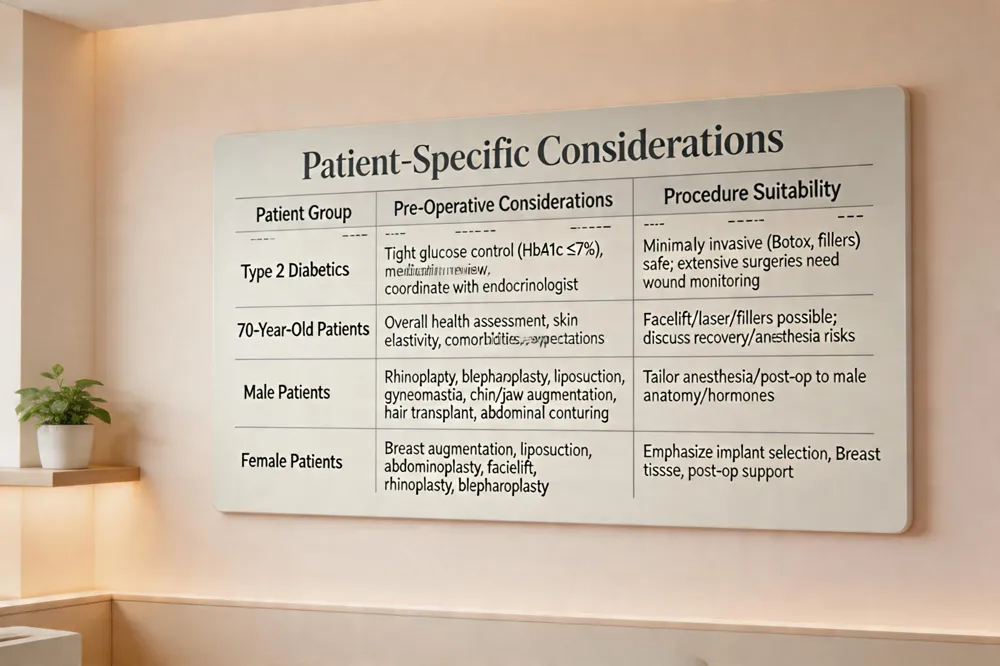
A 70‑year‑old may be a candidate for a facelift if overall health is good and expectations are realistic. The surgeon assesses skin elasticity, bone structure, and comorbidities before recommending a traditional deep‑plane lift, a less invasive mini‑lift, laser resurfacing, or fillers. Longer recovery and heightened anesthesia risks are discussed so the patient can weigh benefits against potential complications.
Most common male procedures include rhinoplasty, blepharoplasty, liposuction, gynecomastia surgery, chin/jaw augmentation, hair transplantation, and abdominal contouring. For women, breast augmentation, liposuction, abdominoplasty, facelift, rhinoplasty, and blepharoplasty dominate the surgical landscape.
Facial plastic surgery encompasses facelift (rhytidectomy), brow/forehead lift, blepharoplasty, rhinoplasty, otoplasty, chin/cheek/jaw implants, lip augmentation, facial fat grafting, and buccal fat removal, each tailored to improve aesthetic harmony or restore function.
Recovery, Healing, and Post‑Op Support
Recovery Timelines & After‑Care Options
| Procedure | Initial Recovery (Days) | Return to Light Activities | Full Activity / Exercise |
| Tummy Tuck (Abdominoplasty) | 2 weeks limited activity | 2 weeks (light chores, driving) | 6‑8 weeks (vigorous exercise) |
| Breast Lift (Mastopexy) | 1‑2 weeks limited activity | 1‑2 weeks (office work, routine) | 4‑6 weeks (heavy lifting, intense workouts) |
| Combined Tummy Tuck + Breast Lift | Recovery dictated by abdominoplasty | Same as tummy tuck | Same as tummy tuck |
After‑Care Facility Options
| Facility Type | Typical Services |
| Home Recovery (Family Support) | Basic nursing, meals, childcare assistance |
| Skilled‑Nursing Home | 24‑hour nursing, medication management, vital‑sign monitoring |
| Short‑Stay Rehabilitation Center | Physical therapy, wound care, physician coordination |
| Outpatient Recovery Suite (e.g., Beverly Hills Surgical Aftercare, Aura AfterCare, Prestige Surgical Aftercare) | 24‑hour nursing, medication management, vitals monitoring, direct physician communication |
| (https://rank-ai-generated-images.s3-us-east-2.amazonaws.com/4561c752-74b2-4d66-95f5-e7121f01f6f2-banner-e21a0259-df7c-46ad-84e0-bc60c3423d08.webp) | |
| Healing acceleration tips: Follow your surgeon’s postoperative orders, keep incisions clean and dry, wear prescribed compression garments, and attend all follow‑up visits. Stay well‑hydrated and eat a protein‑rich, vitamin‑dense diet (lean meats, leafy greens, fruit, bone broth) to support tissue repair. Avoid smoking, vaping, and alcohol for at least two weeks before and after surgery, as they impair circulation. Begin gentle, surgeon‑approved movement—short walks and light house tasks—once cleared, and enlist help for meals and childcare during the first 48‑72 hours. |
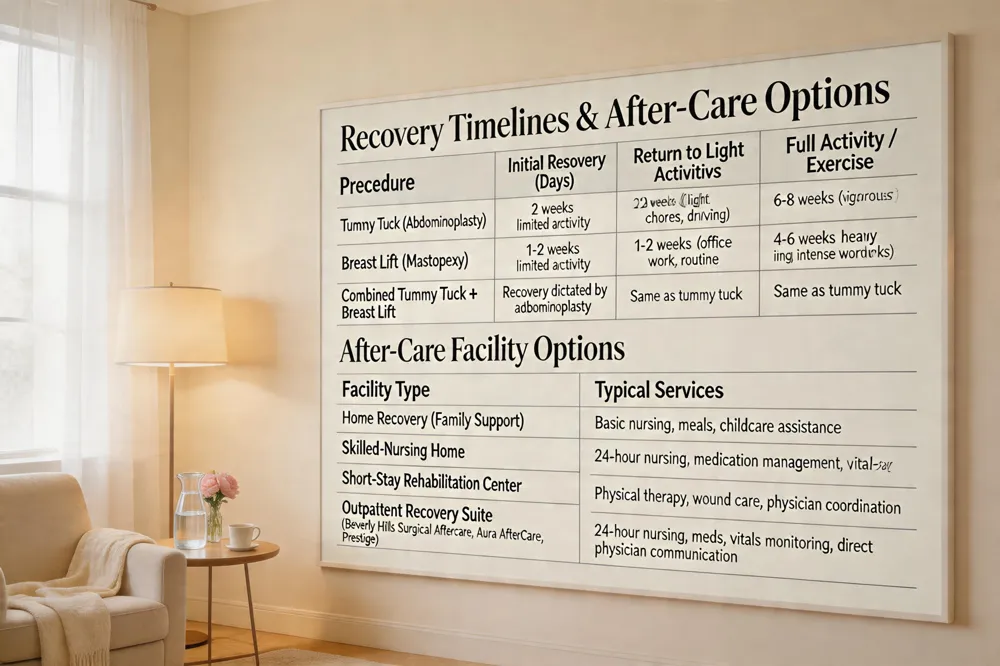
Typical recovery for a tummy tuck and breast lift: A tummy tuck generally requires two weeks of limited activity before light chores and driving, with most patients feeling back to normal tasks by weeks 3‑4; full core strength and vigorous exercise resume at 6‑8 weeks. A breast lift is milder—office work and routine activities return in 1‑2 weeks, while heavy lifting and intense workouts are postponed for 4‑6 weeks. When combined, the abdominal healing dictates the overall downtime.
After‑care facilities: Patients can recover at home with family support or choose professional settings such as skilled‑nursing homes, short‑stay rehabilitation centers, or outpatient recovery suites. Examples include Beverly Hills Surgical Aftercare, Aura AfterCare, and Prestige Surgical Aftercare, all offering 24‑hour nursing, medication management, vital‑sign monitoring, and coordinated physician communication.
Non‑surgical cosmetic procedures: These are incision‑free treatments like Botox and dermal fillers, laser or chemical peels, radiofrequency/ultrasound skin tightening, and non‑invasive fat reduction (cryolipolysis). They stimulate collagen, add volume, or contour tissue with minimal downtime, allowing patients to maintain a youthful appearance without surgery.
Educational Pathways and Frequently Asked Concerns
Training, Procedures, and Recovery FAQs
| Topic | Summary |
| Plastic Surgery Residency | Integrated pathway: 6 years; Independent route: 5 years general surgery + 3 years plastic surgery fellowship (≈8 years total). Board‑certified after passing the American Board of Plastic Surgery exam. |
| Mommy Makeover | Combines abdominoplasty, breast surgery (augmentation, lift, or reduction), and often liposuction. Recovery follows the most extensive step (abdominoplasty): 2 weeks limited activity, light work by weeks 3‑4, moderate exercise by weeks 5‑6, full results by 6‑8 weeks (swelling may persist up to 6 months). |
| Most Demanding Recoveries | 1. Abdominoplasty – 2‑3 months swelling, long scar maturation |
- Rhinoplasty – peak swelling 10‑14 days, residual changes up to 1 year |
- Facelift – bruising/swelling peak day 3, full result 6‑12 months |
- Breast Augmentation – 4‑6 weeks before strenuous activity, scar remodeling 3‑6 months |
- Extensive Liposuction – compression garment 4‑6 weeks, contour refinement 6‑12 months | | Facelift for Seniors (≈70 y) | Require good overall health, realistic expectations, and awareness of reduced skin elasticity and healing capacity. Options may include mini‑lift, deep‑plane technique, or adjunctive laser resurfacing. Risks: prolonged swelling, bruising, cardiovascular/anesthetic complications. | | FAQs | • Length of plastic surgery residency: 6 years (integrated) or ≈8 years (independent). | • Mommy makeover recovery: see above. | • Top five worst surgeries to recover from: see “Most Demanding Recoveries”. | • Should a 70‑year‑old get a facelift?: Requires personalized health assessment; less invasive options often safer. | ](https://rank-ai-generated-images.s3-us-east-2.amazonaws.com/4561c752-74b2-4d66-95f5-e7121f01f6f2-banner-547e9ac1-c740-4437-9045-85236294a228.webp) A Board‑certified plastic surgeon must complete an accredited residency and pass the American Board of Plastic Surgery exam, typically after a six‑year integrated program or a five‑year general‑surgery residency plus a three‑year plastic‑surgery fellowship (≈8 years total).
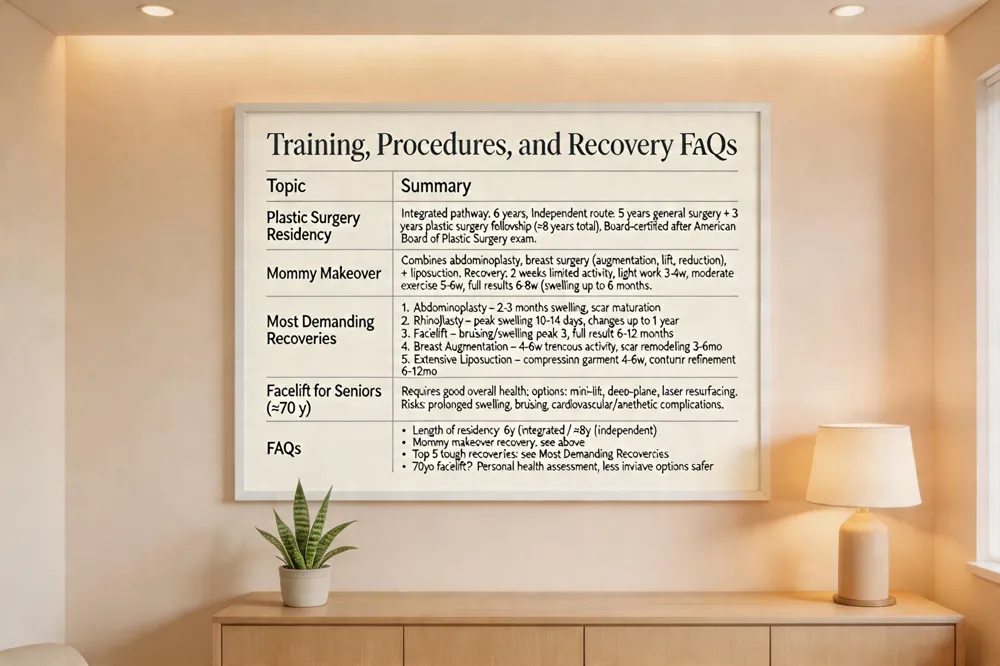
Mommy makeover combines a tummy tuck, breast surgery (augmentation, lift, or reduction) and often liposuction to restore pre‑pregnancy contours. Recovery follows the most extensive step—abdominoplasty—so patients usually need two weeks of limited activity and assistance, can resume light work by weeks 3‑4, moderate exercise by weeks 5‑6, and achieve full results by 6‑8 weeks, though some swelling may linger up to six months.
Surgeries with the most demanding recoveries include abdominoplasty (2‑3 months swelling, long scar maturation), rhinoplasty (peak swelling 10‑14 days, residual changes up to a year), facelift (bruising and swelling peak at day 3, full result 6‑12 months), breast augmentation (4‑6 weeks before strenuous activity, scar tissue remodeling 3‑6 months), and extensive liposuction (compression garment 4‑6 weeks, contour refinement 6‑12 months).
Facelift considerations for seniors: patients aged 70‑years should be medically healthy, have realistic expectations, and understand that skin elasticity and healing capacity decline with age. A less‑invasive mini‑lift, deep‑plane technique, or adjunctive laser resurfacing may be preferable. Risks such as prolonged swelling, bruising, and potential cardiovascular or anesthesia complications must be weighed against desired aesthetic benefit.
FAQs
- How long is a plastic surgery residency? An integrated pathway lasts six years; the independent route adds a five‑year general‑surgery residency plus a three‑year fellowship (≈8 years).
- What is a mommy makeover and its recovery time? See the paragraph above.
- What are the top five worst surgeries to recover from? See the list above.
- Should a 70‑year‑old get a facelift? A personalized assessment of health, skin quality, and realistic goals is essential; less invasive options may be safer and more appropriate.
Your Next Steps in the Cosmetic Surgery Journey
After reviewing the most common cosmetic procedures—breast augmentation, liposuction, rhinoplasty, abdominoplasty, and non‑invasive options such as Botox and dermal fillers—you now understand the typical recovery timelines, risks, and the critical role of board certification. A personalized consultation lets the surgeon assess your anatomy, health status, and aesthetic goals, ensuring a treatment plan tailored to you. It also provides an opportunity to discuss incision sites, implant choices, compression garments, and postoperative care instructions. Take the next step by scheduling a meeting with a board‑certified plastic surgeon who meets American Society of Plastic Surgeons standards. Their expertise will guide you safely toward the results you desire and long‑term satisfaction for your confidence.