

Setting the Stage: Today’s Body Enhancement Landscape
Body‑enhancement procedures have surged, with the U.S. cosmetic market growing 7 % annually and a 20 % rise in plastic surgeries. Patients increasingly favor natural‑looking results, opting for smaller breast implants, subtle lifts, and regenerative options such as PRP or autologous fat transfer. Minimally invasive technologies—cryolipolysis, radiofrequency, laser‑assisted liposuction—offer quicker recovery and less scarring, aligning with this aesthetic shift. Personalized care is now standard; 3‑D imaging, AI simulations, and clinical treatment plans let surgeons visualize outcomes and tailor procedures to each patient’s anatomy and goals. This blend of growth, and precision defines body‑enhancement landscape. The rise of combination packages—such as tummy‑tuck with breast lift or liposuction with skin‑tightening—offers rejuvenation in a recovery period, further driving demand. Moreover, GLP‑1‑mediated weight loss has created a new cohort seeking post‑weight‑loss contouring, reinforcing the market’s expansion.
1. Miniaturized Implants & Natural Breast Contouring
Miniaturized Implants & Natural Breast Contouring – Key Points
| Trend | Description | Key Benefits |
| Smaller implant sizes (B‑C cup) | Preference for natural silhouette, lower complication rates | Softer feel, smoother upper‑pole slope, reduced revision surgery |
| Motiva teardrop‑shaped implants | Mimic intrinsic breast contour | Enhanced softness, natural look |
| Breast reduction & lift | Emphasis on athletic, balanced profiles | Improved upper‑pole slope, long‑term harmony |
| 45‑55 rule | 45 % fullness above nipple, 55 % below (lateral view) | Prevents “top‑heavy” look, maintains proportion |
| Top 10 trends (excerpt) | Mini‑facelifts, hybrid implant‑fat, subtle body contouring, strategic Botox, male‑focused aesthetics, personalized skin rejuvenation, advanced fat‑grafting, AI‑driven consults, combination surgeries, accelerated recovery | Guides clinical focus and patient counseling |
| In 2025‑2026 patients are favoring smaller breast implants—typically B or small‑C cup sizes to achieve a natural silhouette and reduce long‑term complications. Motiva’s new teardrop‑shaped implants mimic the breast’s intrinsic contour, offering a softer feel and smoother upper‑pole slope. At the same time, breast reduction and lift procedures are gaining momentum, driven by surgeons like Dr. Ronald Bossert and Dr. Tracy Harvey who emphasize balanced, athletic profiles over dramatic volume. |
What is the 45‑55 rule for breasts?
The 45‑55 rule guides surgeons to allocate roughly 45 % of breast fullness above the nipple and 55 % below it when viewed laterally. This proportion creates a gentle upper‑pole slope and a supportive lower pole, preventing a “top‑heavy” look and ensuring lasting harmony with the patient’s frame.
What are the 10 biggest plastic surgery trending topics?
Key trends include: (1) mini‑facelifts with neck contouring, (2) natural‑looking breast aesthetics and hybrid implant‑fat procedures, (3) subtle body contouring, (4) strategic Botox and injectable use, (5) growing male‑focused aesthetics, (6) personalized minimally invasive skin rejuvenation, (7) advanced fat‑grafting and regenerative medicine, (8) AI‑driven virtual consultations, (9) combination surgeries for comprehensive rejuvenation, and (10) accelerated recovery protocols with multimodal pain management.
2. Advanced Autologous Fat Transfer & Regenerative Medicine
Advanced Autologous Fat Transfer & Regenerative Medicine – Summary Table
| Technique | Primary Application | Notable Outcomes |
| Autologous fat grafting (lipofilling) | Facial rejuvenation, lip augmentation, breast enhancement | Natural volume, tissue preservation |
| Micro‑fat grafting | Fine facial contouring | Subtle lift, high precision |
| PRP / PRF adjuncts | Intra‑operative healing support | Reduced bruising, accelerated collagen remodeling |
| ADRCs (stem‑cell‑rich) | Graft retention enhancement | Up to 70 % graft survival at 12 months |
| High‑definition liposuction (HD‑Lipo) | Body sculpting with muscle definition | Athletic curves, minimal invasiveness |
| Renuvion™ (J‑Plasma) | Skin tightening & collagen remodeling | Precise tightening, minimal downtime |
| Emerging “high‑fidelity” aesthetics | Micro‑sprinkles of neuromodulators, bio‑stimulators, exosomes | Undetectable beauty, preserved facial mobility |
| Autologous fat transfer (lipofilling) is now a cornerstone of facial, lip, and breast rejuvenation. Harvested from the abdomen, thighs or other donor sites, the fat is processed and reinjected to restore natural volume while preserving tissue integrity. For facial rejuvenation, micro‑fat grafting supplies subtle lift and contour; lip augmentation gains a soft, lasting fullness; and breast enhancement benefits from a natural‑feel alternative to implants, especially when combined with small‑volume silicone options. |
Regenerative adjuncts such as platelet‑rich plasma (PRP) and platelet‑rich fibrin (PRF) are increasingly used intra‑operatively to accelerate healing, reduce bruising, and stimulate collagen remodeling. Emerging stem‑cell‑rich adipose‑derived regenerative cells (ADRCs) further enhance graft retention and skin quality, offering up to 70% graft survival at 12 months.
Body rejuvenation now often pairs autologous fat grafting with high‑definition liposuction, creating sculpted curves while restoring volume in the buttocks, thighs, and abdomen. This combination satisfies the demand for natural‑looking, tissue‑preserving results.
What is the new trend in aesthetics? The 2026 aesthetic trend emphasizes “high‑fidelity” or “undetectable” beauty, favoring micro‑treatments—tiny “sprinkles” of neuromodulators, bio‑stimulators, and regenerative injectables—that preserve facial mobility while improving texture, bounce, and glow. Regenerative medicine, especially polynucleotide and exosome therapies, drives this shift by prompting the body to produce its own collagen and elastin rather than adding artificial volume.
What is the newest body contouring technology? Renuvion™ (J‑Plasma) delivers precise skin tightening and collagen remodeling through helium‑plasma RF energy, while High‑Definition Liposuction (HD‑Lipo) creates athletic, sculpted physiques by selectively removing deep fat while preserving underlying muscle contours.
3. Non‑Invasive Body Sculpting: Efficacy & Economics
Non‑Invasive Body Sculpting – Efficacy & Cost Overview
| Technology | Mechanism | Typical Cost per Area* | Expected Fat Reduction |
| CoolSculpting® (Cryolipolysis) | Controlled cooling → adipocyte apoptosis | $600 – $1,200 | 5‑10 lb per treated zone |
| Radiofrequency (RF) skin‑tightening | Heat‑induced collagen remodeling | $500 – $1,100 | Modest contour improvement |
| Laser lipolysis | Selective photothermolysis of fat | $550 – $1,250 | Similar to RF, with added skin tightening |
| Ultrasound (UltraShape, Liposonix) | Focused ultrasound → fat cell disruption | $650 – $1,300 | 5‑10 lb per zone |
*Cost ranges reflect 2025‑2026 US market, may vary by region and provider.
Typical protocol: 2‑3 sessions per area for optimal results; realistic expectations essential.](https://rank-ai-generated-images.s3-us-east-2.amazonaws.com/4561c752-74b2-4d66-95f5-e7121f01f6f2-banner-4bb86a16-38f4-46ba-8146-d7e1f7bd4708.webp) Non‑invasive body sculpting has become a mainstream alternative to surgical liposuction, especially for patients who are near their ideal weight and have localized, diet‑resistant fat. FDA‑cleared technologies such as Cryolipolysis (CoolSculpting®), radiofrequency‑based skin‑tightening devices, laser lipolysis, and ultrasound‑based systems (e.g., UltraShape, Liposonix) work by destroying or heating adipocytes, prompting the body to eliminate them naturally over weeks to months. Results are modest—typically a 5‑10 lb reduction in fat volume per treated area—and require multiple sessions (often two to three) for optimal contouring. Realistic expectations are essential; these procedures reshape, not replace, weight‑loss programs.
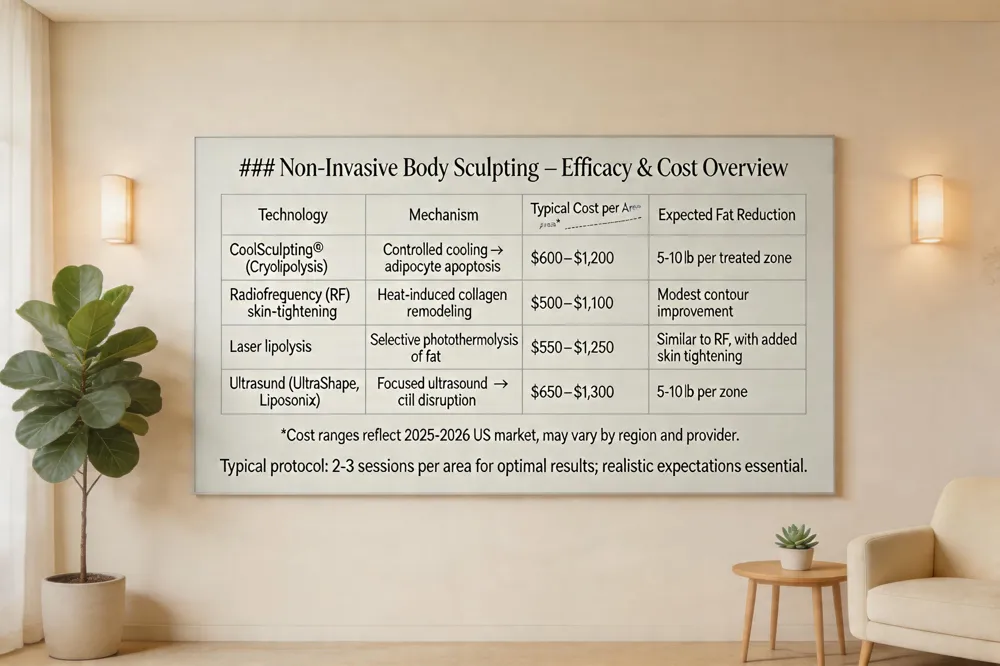
Cost varies by region, provider, and number of treatment zones. CoolSculpting sessions range from $600 to $1,200 per area, so three sessions generally cost $1,800‑$3,600, with discounts possible at high‑volume clinics. Radiofrequency and laser options are similarly priced, while ultrasound devices may be slightly higher. Patients should discuss personalized plans with a board‑certified surgeon to align desired outcomes with budget and safety considerations.
4. Combination & Multi‑Procedure Packages
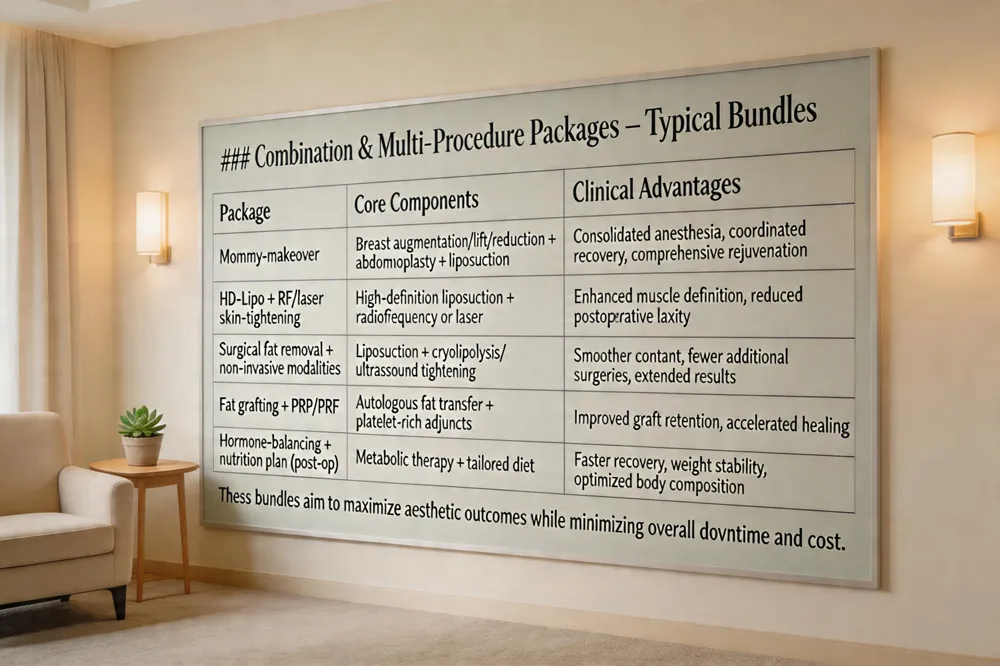
Combination & Multi‑Procedure Packages – Typical Bundles
| Package | Core Components | Clinical Advantages |
| Mommy‑makeover | Breast augmentation/lift/reduction + abdominoplasty + liposuction | Consolidated anesthesia, coordinated recovery, comprehensive rejuvenation |
| HD‑Lipo + RF/laser skin‑tightening | High‑definition liposuction + radiofrequency or laser | Enhanced muscle definition, reduced postoperative laxity |
| Surgical fat removal + non‑invasive modalities | Liposuction + cryolipolysis/ultrasound tightening | Smoother contour, fewer additional surgeries, extended results |
| Fat grafting + PRP/PRF | Autologous fat transfer + platelet‑rich adjuncts | Improved graft retention, accelerated healing |
| Hormone‑balancing + nutrition plan (post‑op) | Metabolic therapy + tailored diet | Faster recovery, weight stability, optimized body composition |
These bundles aim to maximize aesthetic outcomes while minimizing overall downtime and cost.](https://rank-ai-generated-images.s3-us-east-2.amazonaws.com/4561c752-74b2-4d66-95f5-e7121f01f6f2-banner-3536a059-8619-4335-a346-067d4f7b1bc3.webp) Modern aesthetic practice increasingly offers bundled procedures that address several anatomical areas in a single operative window. Mommy‑makeover packages—typically pairing breast surgery (augmentation, lift, or reduction), abdominoplasty and liposuction—provide comprehensive rejuvenation while consolidating anesthesia exposure and recovery time. High‑definition liposuction performed with low‑negative‑pressure technology, is frequently combined with adjunctive radio‑frequency or laser skin‑tightening to enhance muscle definition and minimize postoperative laxity. Single‑session protocols now integrate surgical fat removal with non‑invasive modalities such as cryolipolysis, ultrasonic tightening, or RF‑assisted skin remodeling, delivering smoother, longer‑lasting results without additional surgeries.
What are the body changes in 2026? In 2026, patients are increasingly seeking body‑contouring results that look natural yet are achieved with less downtime, thanks to advances in high‑definition liposuction and laser‑assisted fat remodeling. Metabolic‑boosting therapies, such as personalized hormone‑balancing protocols and post‑procedure nutrition plans, are being integrated into surgical pathways to enhance healing and maintain weight stability. Non‑invasive technologies—radiofrequency, cryolipolysis, and ultrasound‑based muscle tightening—have become more precise, allowing clinicians to sculpt the abdomen, flanks, and thighs without incisions. Digital body‑mapping tools now provide real‑time visual simulations, helping patients set realistic expectations and choose the optimal combination of surgical and non‑surgical options. Together, these trends reflect a shift toward accelerated recovery, tighter control of body composition, and a highly personalized approach to aesthetic body transformation.
What are the 10 biggest plastic surgery trending topics? The biggest trend is smaller, smarter facelifts combined with neck contouring as a standalone priority. Natural breast aesthetics and hybrid breast procedures dominate breast surgery. Subtle body contouring and thoughtful use of Botox and injectables guide body and facial rejuvenation. The normalization of male plastic surgery and the rise of personalized, minimally invasive skin rejuvenation are reshaping patient demographics. Advanced fat‑grafting/regenerative techniques and technology‑driven virtual consultations with AI planning round out the top ten trends.
5. Emerging Aesthetic Styles & Demographic Shifts
Emerging Aesthetic Styles & Demographic Shifts – Quick Reference
| Style / Demographic | Key Characteristics | Popular Procedures |
| Cloud skin (Gen Z) | Soft‑matte, hydrated, breathable finish; matte look with luminous health | Sensory gels, mousse cleansers, talc‑free powders |
| Piratecore, Librarian Chic, Tech Noir | Nostalgic (billowy shirts, cardigans) vs. futuristic minimalism (sleek lines) | Tailored wardrobe styling, makeup trends |
| Male‑focused aesthetics | Growing demand for gynecomastia reduction, liposculpture, non‑invasive buttock lifts | Gynecomastia surgery, body contouring, RF tightening |
| Pre‑juvenation (early‑aging) | Micro‑doses of neuromodulators, bio‑stimulators, PRP, exosomes | Microneedling, low‑dose Botox, exosome therapy |
| Deep‑plane facelift + minimally invasive adjuncts | Natural, undetectable rejuvenation, preservation of facial mobility | Deep‑plane dissection, thread lifts, bio‑stimulators |
These trends reflect a shift toward personalized, low‑downtime, and technology‑enhanced aesthetic solutions.](https://rank-ai-generated-images.s3-us-east-2.amazonaws.com/4561c752-74b2-4d66-95f5-e7121f01f6f2-banner-d67c269e-6f72-42fc-983c-27a68c71d635.webp) Gen Z’s 2026 beauty trend, dubbed “cloud skin,” blends a soft‑matte, hybrid finish with a hydrated, breathable base. The look delivers a matte appearance that resists humidity while keeping the complexion luminous, using sensorial gels, mousse cleansers and talc‑free powders that prioritize skin‑health benefits.
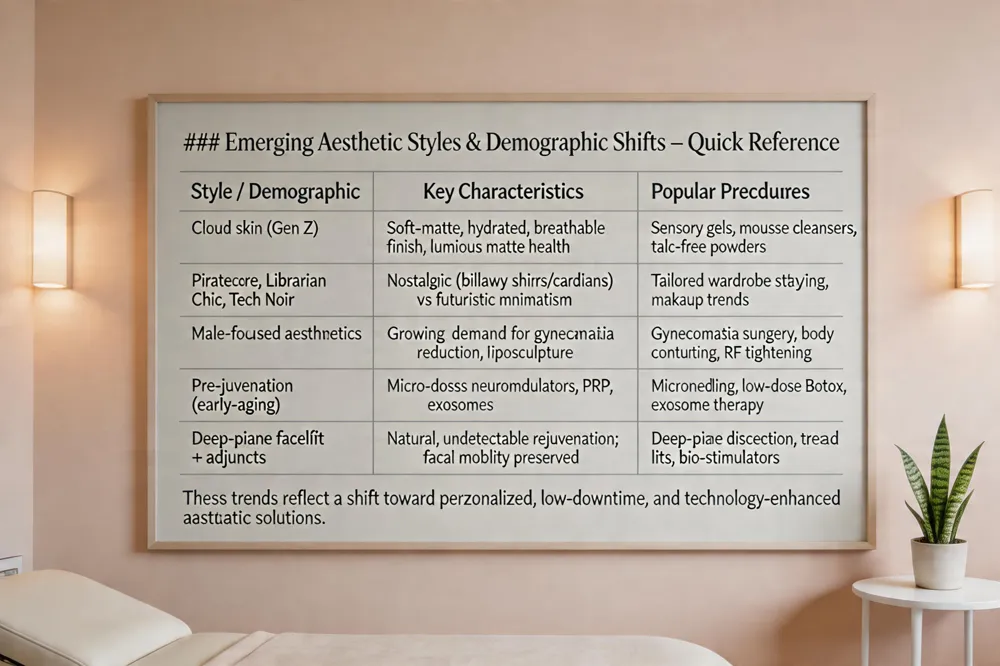
Cultural aesthetics for 2026 span nostalgic and tech‑forward styles: piratecore’s billowy shirts and leather accents, librarian chic’s tailored cardigans and muted tones, and tech noir minimalism’s sleek, dystopian lines. These themes coexist with prep‑and‑coastal influences, shaping fashion, décor, and digital content.
Male‑focused cosmetic demand is surging, driven by procedures such as gynecomastia reduction, liposculpture, and non‑invasive buttock lifts, reflecting broader acceptance of aesthetic enhancement among men.
Preventive, early‑aging (pre‑juvenation) treatments are gaining traction. Patients opt for micro‑doses of neuromodulators, bio‑stimulators, platelet‑rich plasma and exosome therapies that stimulate natural collagen production, preserving facial mobility while improving texture and glow.
The new facelift trend focuses on deep‑plane techniques and adjunctive minimally invasive tools, yielding natural, undetectable rejuvenation.
Looking Ahead: Personalized Patient Care as the Cornerstone
The next wave of aesthetic medicine will be driven by three converging forces. First, AI‑powered 3‑D simulation platforms will enable surgeons to map each patient’s anatomy, test implant sizes, and preview post‑operative contours before the first incision, making consultations data‑driven and realistic. Second, holistic wellness programs will incorporate regenerative adjuncts—platelet‑rich plasma, stem‑cell‑rich fat grafts, and exosome therapies—to accelerate healing, improve skin quality, and sustain results while minimizing downtime. Finally, the prevailing philosophy will remain “enhance, don’t alter,” with customized treatment plans that prioritize subtle, natural‑looking outcomes over dramatic transformations. By uniting cutting‑edge technology, regenerative science, and patient‑centered artistry, practices will deliver truly individualized aesthetic experiences.